Introduction
A refrigerant hose connection can look suitable in a product photograph and still be wrong for the equipment, the technician’s workflow, or the distributor’s replacement parts program. A matching thread is only one part of the decision. Buyers also need to understand where the connection seals, how refrigerant flow is controlled, what remains trapped after isolation, and which operating conditions the assembled tool is rated to withstand.
These questions matter when purchasing refrigerant charging ball valves, automatic low loss fittings, or complete valve and hose assemblies. The products can perform related tasks, but they are not interchangeable descriptions of the same mechanism.
This guide explains the differences, the information to request before a quotation, and a practical sample approval process for importers, tool distributors, and service equipment buyers. It is a purchasing guide rather than an installation procedure. Equipment instructions and the selected tool’s documented limitations must govern actual refrigerant service.
What is the difference between a charging ball valve and a low loss fitting
A charging ball valve provides manual flow isolation. An automatic low loss fitting is designed to restrict refrigerant release as the connection is disengaged. A manually operated valve does not automatically provide the same disconnect behavior as an automatic fitting. Neither description guarantees zero refrigerant release or suitability for every refrigerant.
For a buyer, the useful question is therefore not simply which product is better. It is which connection design matches the service task and how its performance will be demonstrated. Ask the supplier to identify the mechanism rather than relying on the product category name alone.
| Buying question | Manual ball valve | Automatic low loss fitting |
|---|---|---|
| How is isolation initiated | By operating the valve handle | By the fitting’s connection or release mechanism |
| What needs evaluation | Shutoff sealing, handle access, flow path and mating connection | Engagement sequence, release behavior, sealing and service port interaction |
| What should not be assumed | Automatic closure or zero residual release | Universal port compatibility or zero leakage |
| Procurement evidence | Drawing, configuration specific ratings and agreed test records | Mechanism description, compatibility details and agreed disconnect evaluation |
How manual charging ball valves work
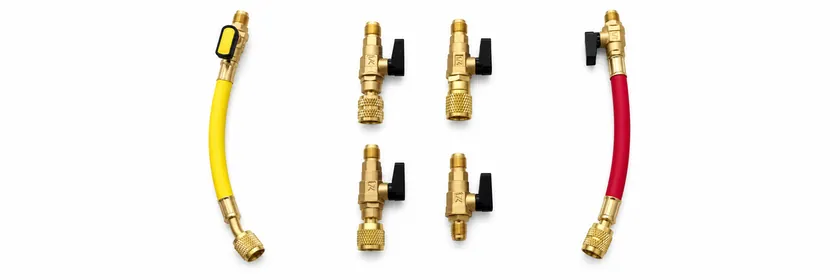
A ball valve uses a rotating element to open or close a passage. In a refrigerant service assembly, the valve may be a separate inline component or integrated into a hose end. The handle provides a visible operating control, but the usable flow path depends on the complete geometry of the product.
Two products with the same nominal connection size may have different internal openings, handle clearance, sealing arrangements, or overall length. Those differences can affect access and handling even before pressure ratings are considered.
Manufacturers distinguish specific valve configurations in their catalogs. For example, YELLOW JACKET’s charging and vacuum valve range lists multiple connection combinations. This illustrates why a photograph and the words “ball valve” are insufficient purchasing specifications; those other products’ ratings or features should not be assigned to an HW item.
Isolation is different from safe pressure management
Closing a valve changes the flow path. It does not establish that every part of an assembly is depressurized. The hose section, adapter cavity, or equipment side may still contain refrigerant. A buyer evaluating a tool should ask how residual contents are managed under the equipment manufacturer’s approved service procedure, rather than treating valve closure as permission to disconnect any pressurized assembly.
What low loss means in a product specification
“Low loss” describes an intended outcome, but the mechanism and evaluation method still need clarification. Some fittings incorporate automatic closure; others use manually controlled isolation close to the service port. A commercial label may group these designs together even when their operation differs.
Request a plain language description of what happens during engagement and disengagement. Identify which part opens the equipment valve core, when the tool seals, and which internal volume remains exposed during release. These are useful drawing review questions, not instructions to experiment on a live system.
If a supplier claims a measured reduction in refrigerant release, ask for the comparison method, equipment configuration, refrigerant, and operating conditions. A percentage without a defined baseline is difficult to evaluate. Avoid copying an attractive claim into a distributor catalog until it is supported for the exact product being purchased.
Start with the service application
Air conditioning and heat pump service
For stationary equipment, review the actual service port, available clearance, intended refrigerant, and approved service practice. A compact valve may suit a restricted location, but a shorter body alone does not prove that the handle can move freely after the hose is attached.
Refrigeration maintenance
Equipment access may vary across display cabinets, cold rooms, and packaged systems. Establish whether one standard assembly will cover the installed equipment base or whether a small number of clearly labeled configurations is more practical. Avoid introducing a large adapter collection without a compatibility matrix.
Automotive air conditioning
Do not assume that a stationary HVAC fitting is suitable for a vehicle service connection. Vehicle applications can require refrigerant specific interfaces and dedicated servicing equipment. The EPA’s motor vehicle servicing guidance describes requirements for that US application. Buyers serving other markets should verify the corresponding local requirements and equipment instructions.
Specify the complete connection
A request reading “quarter inch valve” leaves several important questions unanswered. Nominal fitting terminology is not always the measured outside diameter of a thread. The mating interface must be defined through the relevant connection designation and, where necessary, a dimensioned drawing.
Your request should identify both ends, the male or female arrangement, sealing interface, straight or angled orientation, and any valve core interaction. If a hose is included, specify the length reference and the position of the valve within the assembly.
Clear photographs can help a supplier understand an existing connection, but photographs do not replace critical dimensions. Include a drawing or a traceable equipment reference when the fit is important. For a replacement item, retain an approved physical sample so that future purchases can be compared with the same reference.
Check the physical envelope
Connection compatibility includes access. Ask for overall length, maximum body width, handle movement, and the space needed to attach or detach the fitting. A correct thread can still produce an unusable tool when a neighboring panel, pipe, or service port prevents the operator from handling it as intended.
Separate material descriptions from verified ratings
Metal color is not material certification. A yellow metal body may be described commercially as brass or copper alloy, while the exact alloy, manufacturing method, plating, and internal components remain unspecified. If those details matter to your application or customer requirements, include them in the purchase specification.
The same principle applies to seals. A named sealing material is useful information, but it does not establish compatibility with every refrigerant, lubricant, temperature, or exposure condition. Ask the supplier to confirm the complete assembly’s intended use and to identify any relevant restrictions.
Working pressure, temperature limits, and refrigerant suitability should refer to the selected configuration. A hose rating cannot automatically be transferred to an attached valve, and a component’s burst figure is not its permissible operating pressure. Review the assembly as a system rather than collecting the most impressive number from each component.
What to check during sample approval
A useful sample evaluation produces a decision record, not only a photograph saying “approved.” Before shipment of samples, agree which characteristics will be inspected and which tests require the supplier’s qualified personnel, equipment, and documented procedures.
Start with identification: sample code, drawing revision, connection configuration, and any substitutions. Then review dimensions, visible workmanship, protective caps, and the information supplied with the product. Check the intended handle orientation and mating fit using appropriate reference components under controlled, nonhazardous conditions.
For pressure integrity, shutoff behavior, or disconnect performance, request a written evaluation method suitable for the product. The record should identify the test item, equipment, conditions, acceptance criterion, and result. This article does not prescribe a test pressure or tell an untrained buyer to pressurize a sample.
Where a supplier proposes destructive testing, agree how samples are selected and identified. The tested item must not return to saleable stock. Keep the accepted sample and its records tied to the order specification; otherwise an apparently similar later batch can become difficult to compare.
Discuss your valve configuration
A practical distributor purchasing example
Consider an illustrative distributor building a service tool range for two groups of contractors. One group prioritizes compact manual control near the hose end. The other needs a defined automatic disconnect mechanism for a particular equipment fleet. These are separate customer requirements even if both groups use the phrase “low loss valve.”
The distributor should create two specifications rather than ask for a single universal item. Each should list the connection arrangement, intended equipment, required documentation, and evaluation method. Samples can then be reviewed against the correct task instead of being ranked mainly by appearance or price.
Packaging should preserve that distinction. A technician should not need to interpret a small product photograph to tell the two configurations apart. Use a clear item code, connection description, and accurate application limits. Include a revision reference on the distributor’s own specification sheet so that a later reorder does not silently change the product definition.
This example is a proposed buying workflow, not a claim about a completed HW shipment or a measured field result. Its value is in making purchasing decisions repeatable before an order reaches the warehouse.
Common purchasing mistakes and how to avoid them
Ordering by color or shape. Similar bodies can contain different seals, threads, or internal mechanisms. Use the item specification and approved sample as the purchasing reference.
Using the highest displayed pressure number. A burst value, a component test figure, and a working pressure are different information. Require the applicable assembly rating and its conditions.
Assuming every connection can be adapted safely. An adapter changes the assembly and may introduce additional limitations. Obtain configuration specific guidance instead of treating adapter availability as compatibility approval.
Ignoring spare parts. Ask whether replacement seals or other serviceable parts are available for the selected design and how the item is identified. Do not promise field serviceability unless the product instructions actually allow it.
Approving samples without controlling reorders. Tie the sample, drawing, label, and inspection requirement to the purchase order. A good first sample does not by itself establish consistency across future batches.
Build an RFQ that supports comparable quotations
A focused request for quotation should describe what the customer needs to accomplish and what evidence will establish acceptance. Include the product type, connection details, refrigerant and operating requirements, expected order quantity, destination, packaging needs, and requested inspection documents.
Ask each supplier to mark requirements as confirmed, requiring clarification, or unavailable. This is more informative than asking whether everything is “standard.” A quotation that clearly identifies an unresolved connection is easier to manage than a low quotation that leaves the buyer to discover the uncertainty after shipment.
Evaluate the cost of specification errors alongside unit price. Repacking, customer returns, duplicate inventory, and missing technical documents can affect the commercial result. A slightly more detailed RFQ can reduce those avoidable differences before buyers compare suppliers.
Keep the product description consistent after approval
A final sample decision should flow into every place the item is described: quotation, purchase order, packaging artwork, distributor listing, and replacement parts record. If one document calls the item an automatic low loss fitting while another shows a manual ball valve, customers may form the wrong expectation even when the shipped product matches the sample.
Create a short description that identifies the mechanism and both connections before adding promotional language. For example, a controlled description can specify a manual valve with an agreed connection arrangement and refer to the approved drawing for details. It should not add unverified compatibility, pressure, or refrigerant release claims merely to make the listing sound complete.
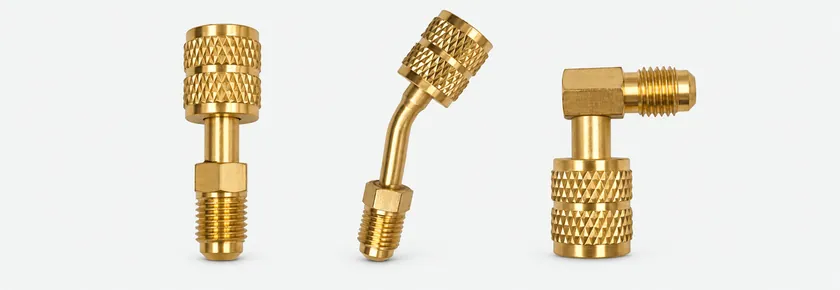
Use the approved product photograph as an identification aid. Where the picture shows a family of products, explain that the quotation concerns one selected configuration. A buyer should be able to connect the quoted item code to a drawing, a sample reference, and the image used by the sales team.
Finally, define who can change the description. A salesperson, packaging vendor, or marketplace editor should not independently expand the application claim. A simple review step can prevent a carefully approved product from acquiring unsupported promises as it moves through the sales process.
Frequently asked questions
Are ball valves and low loss fittings the same thing
No. A ball valve is a manually operated isolation device. Low loss describes release control and may refer to a different mechanism. Ask how the specific fitting operates during connection and release rather than relying on the label alone.
Does a closed charging ball valve mean no refrigerant can escape
No. Closing the valve does not prove that every part of the assembly is free of pressure or refrigerant. Residual contents depend on the configuration and approved service procedure. Do not advertise zero release without configuration specific evidence.
Can one valve be sold for every refrigerant
That claim requires evidence covering the valve, seals, connections, pressure range, and temperature conditions. A general material description or matching thread is insufficient. Obtain written compatibility information for the applications you intend to support.
Should a distributor choose separate valves or complete hose assemblies
Separate valves can support a modular product range, while complete assemblies can simplify configuration control. The better option depends on customer equipment, assembly responsibility, documentation, replacement parts, and the number of variants the distributor can support accurately.
What should I send when asking for a quotation
Send the product application, both connection details, preferred orientation, required ratings, estimated quantity, and destination. Add a drawing or photographs of the mating components and identify any private label, packaging, or inspection requirements.
Conclusion
Select a refrigerant charging connection by its mechanism, documented compatibility, physical fit, and approval evidence. Manual ball valves and automatic low loss fittings can serve different purchasing needs. Clear specifications and a controlled sample review help buyers select a product range that customers can understand and use according to its instructions.
Send your valve requirements to HW
Planning a distributor range or a custom valve and hose assembly? Send your requirements to HW with the connection drawing, intended application, quantity, and shipping destination. Ask for the relevant catalog information and confirmation of the proposed configuration before approving an order.