Introduction
Refrigerant charging hoses are often purchased as a familiar red, blue, and yellow set. For a professional buyer, however, color is an identification aid rather than a technical specification. The correct hose depends on the refrigerant, equipment connections, working conditions, service task, and requirements of the complete assembly.
A product can fit a service port yet remain unsuitable for the intended duty. An impressive burst pressure does not establish an allowable working pressure, and an adapter that connects two components does not automatically make them compatible. These distinctions become important when a distributor must support customers using different equipment generations.
This guide provides a specification framework for HVAC tool importers, wholesalers, and equipment buyers. It covers pressure ratings, hose construction, connection details, length, A2L questions, sample evaluation, and shipment inspection. Actual refrigerant handling must follow the selected equipment and tool instructions and be performed by appropriately qualified personnel.
What should buyers check before ordering charging hoses
Specify the exact refrigerant, permitted working pressure and temperature range, hose bore, length, connections at both ends, valve arrangement, and intended task. Ask for compatibility and ratings for the complete assembly. Review samples and agree on inspection evidence before approving a bulk order.
This short specification prevents a supplier from making assumptions that may differ from your customer’s application. It also gives competing suppliers a common basis for quotation. A low unit price has limited meaning if one offer includes a different connector, a shorter hose, or no agreed test record.
| Specification field | What to provide or request |
|---|---|
| Application | Charging, recovery support, pressure measurement, or a separately approved vacuum task |
| Refrigerant | Exact designation and relevant lubricant or exposure conditions |
| Ratings | Assembly working pressure and temperature limits with supporting documentation |
| Hose geometry | Internal diameter, length definition, tolerance and bend requirements |
| Connections | Both mating interfaces, orientation, sealing arrangement and core interaction |
| Commercial controls | Item code, sample reference, packaging, traceability and inspection agreement |
Understand working pressure before looking at burst pressure
Working pressure describes a permitted operating limit under stated conditions. Burst pressure describes a destructive performance threshold established through a defined test. The two figures answer different questions. A buyer must not treat the larger burst number as an allowable service pressure.
For a published manufacturer example, Fieldpiece’s HR1BM product information lists separate working and burst pressure values. Those figures apply to that specific manufacturer’s product. They illustrate how ratings should be presented; they are not specifications for HW hoses or for an unspecified hose bought from another supplier.
Ask whether the documentation covers the hose assembly or only the flexible hose material. Connectors, crimps, shutoff valves, and adapters introduce additional components and limitations. Any assembled configuration must be accepted for the intended use as a whole, rather than approved by selecting the highest rating from its individual parts.
Keep the rating conditions attached to the number
A pressure number without temperature conditions, product identification, or a document reference is incomplete purchasing information. Record the applicable limitations in the specification and check that packaging and sales listings describe them consistently. Where requirements remain unresolved, stop the approval process instead of filling the gap with a competitor’s published figure.
Match hose construction to the intended exposure
A hose normally includes an internal passage, reinforcement, an outer protective structure, and attached end fittings. Each contributes to performance. The inner material encounters refrigerant and lubricant, reinforcement supports mechanical requirements, and the outer surface faces handling, abrasion, storage, and environmental exposure.
Construction descriptions such as “barrier hose” are useful starting points, but the exact material and documented application still matter. Ask what the description means for the selected model and whether relevant permeability, pressure, temperature, or compatibility information is available.
Do not select solely by apparent softness. A flexible sample may feel convenient in the hand without demonstrating long term suitability. Conversely, a stiffer construction may need more connection clearance. Evaluate the characteristics relevant to your customers rather than using a single tactile impression as a quality score.
Consider storage and replacement information
Ask how hoses should be protected, inspected, and removed from service. A distributor needs a clear process for identifying damage or a lost connection component. Replacement advice should come from the product instructions rather than an unsupported universal service life printed in a catalog.
Confirm both end connections independently
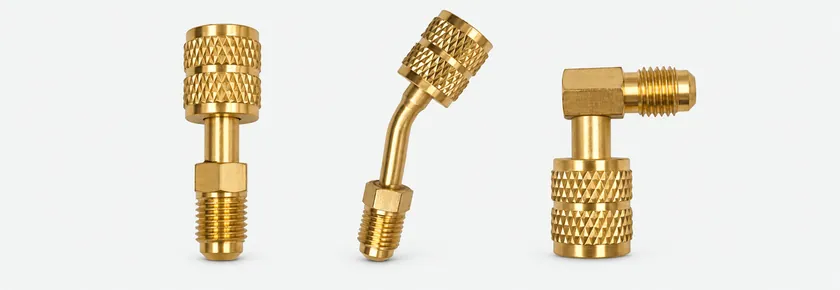
The manifold end and equipment end may require different fittings. Define each end separately, including the connection designation, male or female form, sealing interface, orientation, and any valve core depressor or shutoff mechanism.
Commercial sizes such as 1/4 SAE and 5/16 SAE are connection designations, not sufficient instructions to measure a thread with an ordinary ruler. Request a dimensioned drawing, the applicable interface description, or a traceable equipment reference. A compatible interface must seal correctly, not merely allow the first few turns of engagement.
Check swivel access and the room needed to operate a valve. A 90 degree fitting may improve clearance in one cabinet but obstruct a neighboring service point in another. Include the restricted space in installation preparation: photographs with dimensions can make an otherwise vague access problem understandable to the supplier.
Choose hose length and bore for the task
A longer hose can improve reach, but it can also add handling bulk and internal volume. For the same internal diameter, doubling the length doubles the hose’s internal geometric volume. That relationship does not itself predict a fixed amount of refrigerant loss; contents also depend on refrigerant state, conditions, and the approved service procedure.
The useful purchasing objective is sufficient reach without unnecessary length. Consider where the manifold, scale, cylinder, and equipment will be positioned under the equipment manufacturer’s instructions. Then define the measurement convention: flexible section length and overall assembly length are not necessarily the same.
Internal bore also affects the service path. However, a larger hose does not eliminate restrictions inside a small adapter, valve, core, or manifold passage. Review the complete path rather than promising a universal percentage improvement from hose diameter alone.
Charging hoses and dedicated vacuum hoses are different selections
Do not assume a hose marketed for charging is the preferred product for deep evacuation. Vacuum suitability, internal restrictions, and the rest of the setup need separate evaluation. Appion’s evacuation guidance discusses how flow restrictions affect evacuation equipment. Its application specific guidance should not be converted into a blanket rating for another supplier’s hose.
Evaluate A2L compatibility using product specific evidence
“Suitable for A2L” should not be accepted as a color code or a general claim about all hoses. Ask which refrigerants and exact product configurations are covered, what operating limitations apply, and which documentation supports the intended use.
Manufacturers can publish compatibility for named product ranges. For example, Mastercool’s hose product page states suitability for specified refrigerant classes alongside configuration information. This is an example of model related documentation, not proof that a visually similar hose from another source has the same suitability.
Also assess the wider service setup. A hose connection does not make a recovery machine, vacuum pump, detector, cylinder, or existing refrigeration system suitable for a different refrigerant. In particular, a matching adapter is not authorization to convert equipment to an alternative refrigerant. Ask the equipment manufacturer and follow the applicable market requirements.
For the US market, EPA guidance on refrigerant transitions addresses restrictions on using flammable or mildly flammable refrigerants in systems not designed for them. Keep regulatory review distinct from supplier product selection, especially when distributing across multiple countries.
Choose a valve arrangement that customers can identify
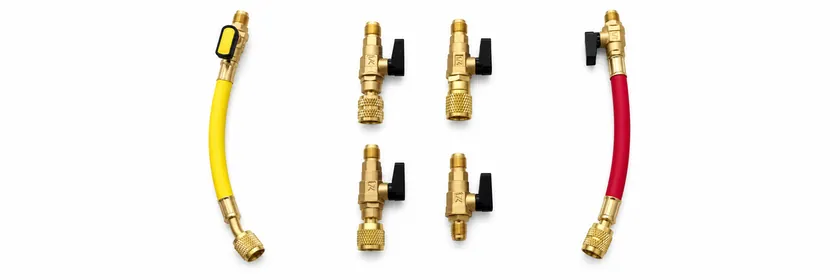
Open hose ends, manual ball valves, and automatic low loss mechanisms create different handling expectations. The product listing should explain the design, connection sequence, and limitations accurately. A short phrase such as “low loss hose” may not tell a customer whether closure is automatic or manual.
For distributors, the issue extends to item coding. If two hose sets differ only in their end mechanism, give them distinct descriptions and keep photographs aligned with the correct variant. A purchasing system that stores only color and length can allow the wrong assembly to be reordered.
For a more detailed comparison of the mechanisms, use our companion guide on charging ball valves and low loss fittings. Confirm the exact configuration rather than assuming the comparison describes every product sold under either name.
Discuss your hose specification
Review samples before approving a hose range
Begin with a document check. The sample code, drawing, supplier quotation, and requested assembly should agree. If a substitution has been made, record it openly and decide whether it requires a new approval.
Inspect visible condition, end protection, connection workmanship, hose identification, and the consistency of the assembly. Compare the length using the agreed measurement convention. Verify that the connections match suitable references under controlled conditions and that the intended orientation is practical.
Factory testing should follow a documented procedure appropriate to the selected product. Request the method, equipment identification, relevant calibration status, conditions, acceptance criteria, and traceable results. Do not interpret a short video of a gauge as complete evidence of pressure integrity, chemical compatibility, fatigue performance, or service life.
Separate non-destructive routine checks from qualification or destructive tests. If the supplier performs a burst test on a sample, the record should identify that sample and its relationship to the proposed production configuration. The result cannot be represented as a working pressure or as a test performed on every shipped hose.
Plan labeling and shipment inspection together
Packaging protects the tool and communicates its identity. Agree on item codes, connection descriptions, hose length, quantity per pack, and any verified use limitations. Use the actual approved assembly in product photographs; do not let attractive artwork conceal a different valve or connector.
A shipment inspection should compare the goods with the approved specification, sample reference, packing list, and order quantities. Inspectors should know which characteristics require measurement, which require document review, and which require a qualified test procedure.
Traceability should connect the shipment to the supplier’s batch or production records at an agreed level. This supports complaint investigation and reorder control. It does not require publishing confidential manufacturing details on a product page, but the buyer and supplier need a workable method for retrieving the relevant records.
Use a comparison sheet before comparing prices
Create one row per proposed hose assembly and record the same fields for every supplier: refrigerant declaration, connection details, length, bore, working conditions, valve mechanism, labeling, inspection scope, and unresolved questions.
Mark missing information as unconfirmed. Do not fill an empty rating cell with a common industry value or an assumption taken from a similar online listing. Where a requirement is essential, treat missing evidence as an approval issue rather than a small administrative omission.
Commercial comparisons should also include sample costs, packaging differences, replacement availability, inspection responsibility, and freight assumptions. This makes the quotation useful to a purchasing team and helps explain why two apparently similar hose sets may have different total costs.
Apply the checklist to different customer groups
A distributor supporting several equipment families
Start by listing the equipment interfaces your customers actually encounter. Group requirements by verified connection and application rather than creating one product described as suitable for everything. Decide whether clearly separated hose sets are easier to support than an expanding collection of adapters. Include replacement availability and product identification in that decision, because warehouse errors can undermine an otherwise suitable technical choice.
An equipment buyer with a restricted service space
Provide the supplier with a drawing of the available space and the mating interface. Request the complete assembly envelope, including the connector and valve movement. An illustrative sample review can check access with an appropriate unpressurized reference fixture before any qualified functional evaluation. Record the fixture or equipment reference so that a later connector revision does not invalidate the original access decision.
A private label buyer preparing a new catalog
Approve technical descriptions before finalizing packaging artwork. The image, hose length, connection labels, operating limitations, and item code should describe the same assembly. If the supplier cannot yet confirm a requested rating or refrigerant, keep the claim out of the catalog and mark it as an open approval item internally. A blank specification cell is a signal to investigate, not an invitation for the marketing team to select a familiar number.
Across these scenarios, the purchasing method remains the same: define the customer’s use, confirm the assembly, and retain the evidence. The resulting hose range may be smaller than a generic catalog, but each item has a clearer reason to exist and a more useful description for the buyer.
Frequently asked questions
Can I select a charging hose by burst pressure alone
No. Confirm the permitted working pressure, temperature range, refrigerant compatibility, and complete assembly configuration. Burst pressure is a different test result and must not be used as an allowable operating pressure.
Are red blue and yellow hoses technically different
Color often helps users identify hose roles, but it does not independently establish a pressure rating, material, or refrigerant approval. Check the specification and markings for each product rather than treating color as technical evidence.
Can an R410A hose automatically be used with R32 or R454B
Do not assume compatibility from the product name. Obtain written confirmation for the exact hose assembly and intended refrigerant, and verify the wider service equipment and relevant operating limitations. Connection fit alone is not sufficient.
Is a longer hose always more convenient
No. Additional reach may help, but extra length adds handling bulk and internal volume. Choose a length that suits the planned equipment layout and specify how that length is measured so that quotations and received goods are comparable.
What information helps a supplier quote a custom hose assembly
Provide the application, refrigerant, required operating conditions, both connections, desired bore and length, valve arrangement, quantity, and destination. Attach drawings and identify any inspection records, packaging, or private label requirements.
Conclusion
A reliable hose purchasing decision connects the application, the complete assembly specification, and the evidence needed for approval. Separate working pressure from burst pressure, confirm both interfaces, and obtain refrigerant compatibility for the selected configuration. Clear labeling and shipment inspection then help carry those decisions into repeat orders.
Request a hose configuration review
Building a refrigerant charging hose range for your market? Send HW your customer requirements and ask for the relevant catalog information. Include the intended application, connection drawings, length, order quantity, destination, and documentation expectations so that the proposed assembly can be discussed on a clear basis.